
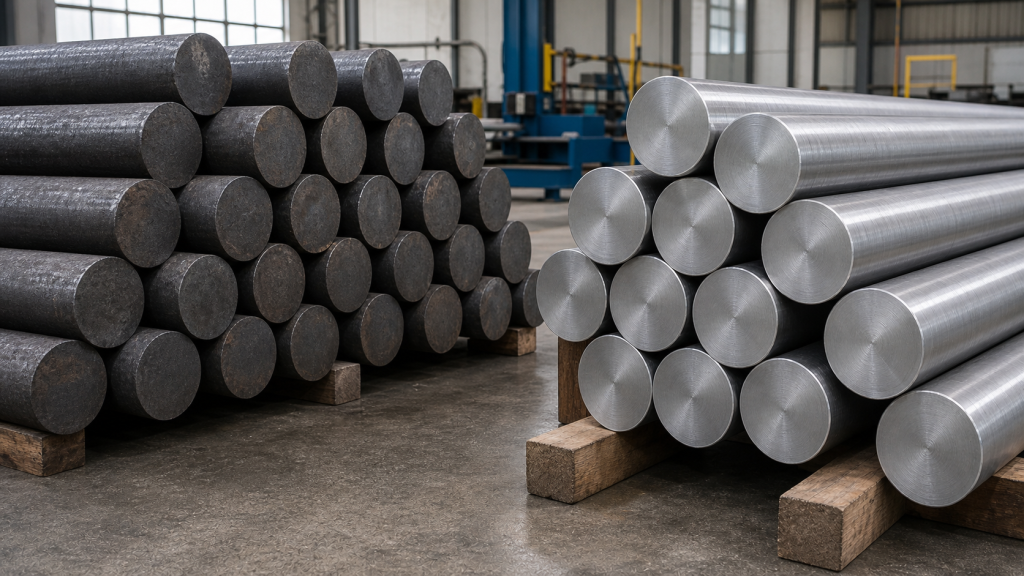
Hot Rolled vs Forged Steel Round Bar: How to Choose for Shafts and Heavy Parts
Hot rolled and forged steel round bar can share the same grade name, yet they behave very differently once cutting, heat treatment, and final inspection begin. Buyers usually notice the difference too late. The order arrives, the surface looks acceptable, but machining allowance is uneven, upset forging yield is poor, or the part needs more stock removal than planned. At that point, the cheaper line on the quotation is no longer the cheaper choice.
This comparison is most useful when the drawing already points to round bar, but the required supply route is still open. A purchasing team may be quoting shaft blanks, large pins, sleeves, mandrels, or heavy-duty machined parts. In those cases, the real question is not which route sounds better. It is which route fits section size, forging reduction, surface expectation, internal soundness, and the amount of stock that will still be removed later.
If the outer layer will be cut away heavily, hot rolled round bar is often enough. If the order needs cleaner stock, heavier section reliability, or forging-ready structure before the shop starts work, forged round bar usually deserves its own quotation line.
What is the real difference between hot rolled and forged steel round bar?
The practical difference is supply route, not grade label. Hot rolled round bar comes from rolling at elevated temperature and is commonly chosen for general stock, wider size availability, and lower starting cost. Forged round bar starts from cast or rolled feedstock that is worked by forging, usually to improve section integrity, reduce segregation risk in heavier sizes, and suit demanding forged or machined components.
That does not mean forged bar is always superior in every order. It means the buyer is paying for a different manufacturing route and a different starting condition. A hot rolled bar may carry mill scale, broader surface variation, and a wider tolerance range depending on size and standard. A forged bar often arrives with a rough forged skin, cropped ends, and a route better suited to larger sections or more demanding downstream forging and machining.
When teams compare routes, it helps to separate product family from delivery route. Chinaspecsteel already lists general round bar supply as a core product line. The quotation question is whether the order should stay in a standard hot rolled route or move into a forged route before the material reaches the machine shop.
When is hot rolled round bar the right buying choice?
Hot rolled round bar is usually the right choice when the part still has generous machining allowance, the section is not unusually heavy, and the project does not need forged-route soundness from the start. It is often the sensible option for standard shafts, general machinery parts, rough machined blanks, and jobs where cost control matters more than premium starting condition.
This route works well when the shop will remove the outer layer anyway. If scale, decarburized skin, or minor surface irregularity will disappear during rough machining, paying early for forged stock may not add much value. Hot rolled bar also gives buyers a broad grade range, from carbon steel to alloy steel, through routes such as alloy steel round bar and related standard supply.
The limit appears when size grows, internal quality becomes more sensitive, or the drawing leaves little room for correction. A buyer who only compares price per ton can miss that point. A better test is simple: how much metal will be removed, how large is the section, and what happens if the bar shows more variation than the shop expected?
When does forged round bar justify the extra cost?
Forged round bar usually justifies the extra cost when the order involves heavier sections, forging-ready blanks, stricter internal quality expectations, or high-load parts where the starting route matters before heat treatment and finish machining. Buyers often specify it for large shafts, transmission parts, heavy pins, tool holders, and components that cannot tolerate avoidable material uncertainty.
The main advantage is not appearance. It is better suitability for demanding downstream work. Forged stock is often chosen when the part will later be upset forged, deeply machined from a large diameter, or inspected more closely for internal discontinuity and structure consistency. On these jobs, a low initial price from hot rolled stock can disappear fast if the shop loses yield or needs more rework.
Still, forged bar is not a shortcut around technical definition. The order should still name grade, standard, testing scope, size, heat treatment condition if required, and any document package. If the engineering file accepts grade equivalents, that rule should be stated against the controlling standard, not guessed from a familiar trade name. Chinaspecsteel keeps both material grade and standard reference pages for that reason.
Which comparison points should buyers put on one quotation sheet?
Buyers should compare hot rolled and forged round bar on the same sheet before making a decision. Looking at price alone hides the factors that decide whether the material will actually work. A short comparison table keeps the discussion focused on what changes production risk, not just what changes the unit rate.
| Comparison point | Hot rolled round bar | Forged round bar | What the buyer should ask |
|---|---|---|---|
| Typical use | General stock, rough machining, standard sections | Heavy sections, forged blanks, demanding machined parts | Will the part lose a large outer layer anyway? |
| Surface condition | Mill scale and rolled surface remain | Forged skin remains unless further processed | Does the drawing care about starting surface or only final machining? |
| Section suitability | Good for many common diameters | Often preferred for larger or heavier diameters | At what size does internal quality concern increase? |
| Downstream route | Machining or secondary processing after delivery | Machining, heat treatment, or further forging after delivery | Will the stock be upset forged, deep machined, or heavily stressed? |
| Inspection focus | Standard chemistry and mechanicals as ordered | Often paired with stricter testing requests on heavier jobs | Is UT, traceability, or extra cropping needed? |
| Commercial result | Lower starting price | Higher starting price, lower risk on some jobs | Which option protects total machining yield better? |
This is where many quotations go wrong. A buyer asks for “round bar” and receives only one route. A better RFQ asks for both routes when the route has not yet been fixed by the drawing. That makes cost, lead time, and technical difference visible before purchase approval starts moving.
What should be written in the RFQ before price is compared?
A useful RFQ names the route, not just the grade. Without that, the supplier has to guess whether the inquiry is for standard hot rolled stock or forged round bar. The fastest way to get a usable comparison is to state the part context, the section size, and the downstream process in the first message.
- Name the exact grade and the governing standard.
- State diameter, length, quantity, and whether the requirement is trial, monthly, or project-based.
- Say clearly whether the quotation should cover hot rolled round bar, forged round bar, or both.
- Note the later process: rough machining, finish machining, heat treatment, upset forging, or grinding.
- List any testing or document needs, such as MTC, heat number traceability, UT scope, or third-party inspection.
- Tell the supplier the end use if the part is safety-sensitive or highly loaded.
Those details matter more than long purchasing language. A short RFQ with the right fields gets better answers than a polished email with vague wording. Buyers who are still deciding final route can also refer to the site’s application overview to align the bar route with the part category before the quotation is requested.
Can one be substituted for the other without changing the drawing?
No, not safely by assumption. Hot rolled and forged round bar can sometimes serve the same part family, but substitution should only happen after reviewing section size, process route, quality expectation, and the controlling standard. A familiar grade name does not automatically make the two supply routes interchangeable.
The risk is usually commercial before it becomes technical. A team assumes hot rolled will do, then the machine shop adds extra cutting time or rejects the starting condition. Or a team buys forged stock for a job that would have worked perfectly well in hot rolled condition, which makes the quotation less competitive than it needed to be. Neither problem is solved by repeating the grade name louder.
A careful sourcing partner will ask what the drawing truly needs. Chinaspecsteel should be described honestly here as a China special steel trading supplier, not as a one-route mill source for every order. That is useful to buyers because it allows route comparison, grade cross-checking, and document clarification before the PO is released. When the requirement is clear, the next step is straightforward through the verified contact page.
Frequently asked questions
Is forged round bar always stronger than hot rolled round bar?
Not by default. Final performance still depends on grade, section size, reduction practice, heat treatment, and the actual part design. Forged stock is often selected because it suits heavier or more demanding jobs better, but the route alone does not replace proper grade and condition control.
Should buyers ask for both quotations on the first inquiry?
Yes, when the drawing does not lock the route already. Asking for hot rolled and forged options in the same inquiry helps the team compare cost, lead time, and technical fit before internal approval. It also shows quickly whether the cheaper route is really practical.
Does forged round bar remove the need for machining allowance?
No. Forged stock still needs allowance planning. The route may improve suitability for demanding parts, but it does not create a finished surface or final-size part on its own. Buyers should still define how much stock the shop expects to remove after delivery.
What is the biggest mistake in this comparison?
The most common mistake is comparing only price per ton and leaving the route undefined. That invites a one-line quote but not a safe purchasing decision. Section size, downstream process, testing scope, and application should all be on the table before the route is chosen.
When the route question is settled early, quotation quality improves fast. Hot rolled round bar remains the practical answer for many jobs. Forged round bar earns its place when section size, downstream forging, or reliability demands push the order beyond standard stock. The smart move is to compare both against the real part requirement, not against habit.


 English